Best AI App Builders for MVPs, Internal Tools, and Web Apps
Last updated: 2026-06-28
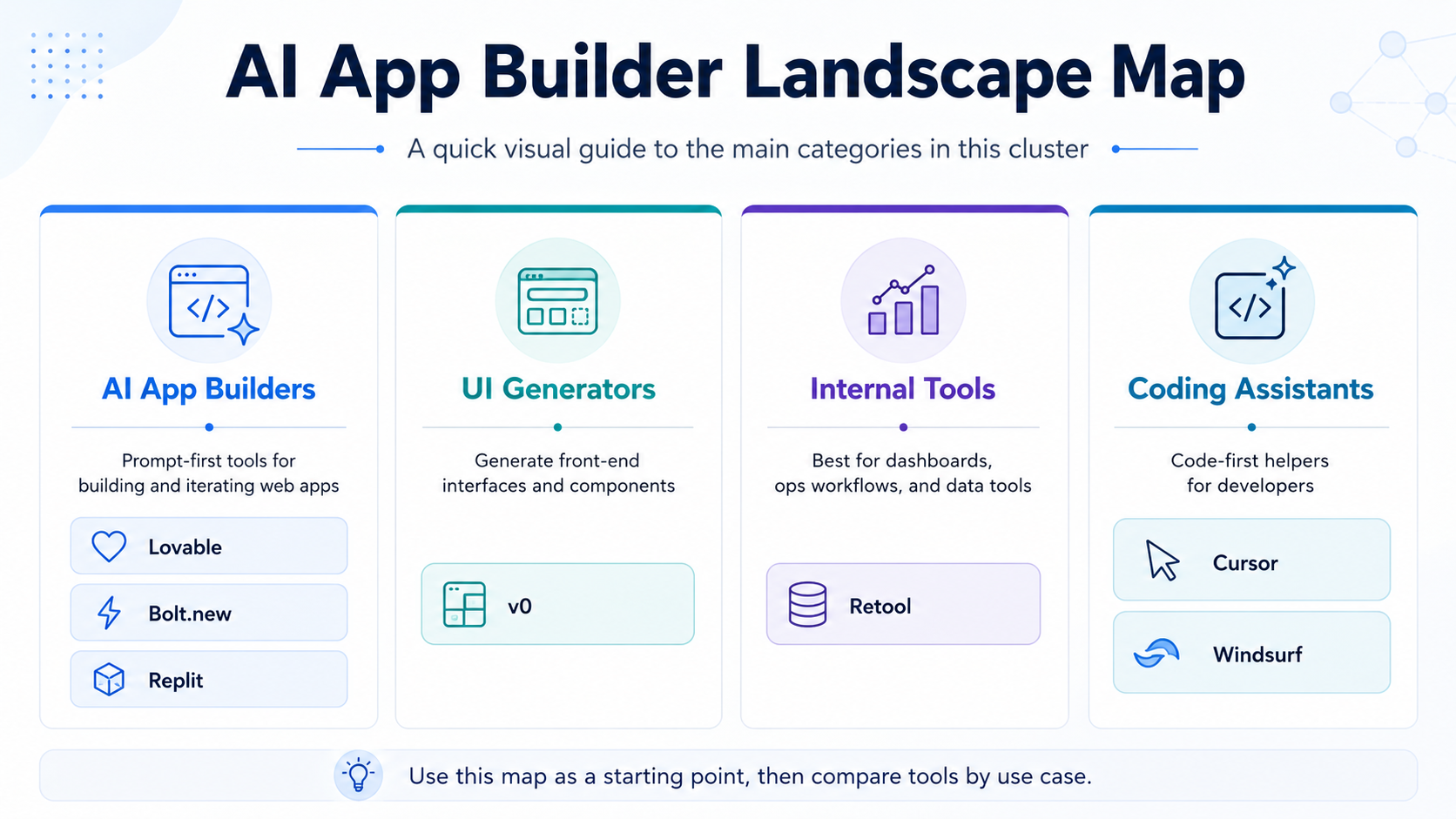
AI app builders are no longer just prompt-to-mockup toys. The strongest tools now help users move from an idea to a working web app, landing page, dashboard, internal tool, or prototype without starting from a blank codebase.
This guide compares the main AI app builder categories and helps you choose the right tool based on what you are trying to ship.
Quick answer
The best AI app builder depends on the job:
| Use case | Better fit | Why |
|---|---|---|
| Non-technical founder building an MVP | Lovable, Bolt.new, Macaly, Replit | Natural-language app generation and fast publishing workflows |
| Frontend-heavy web app or UI prototype | v0, Bolt.new | Strong fit for interface generation, React-style workflows, and fast iteration |
| Internal tools connected to business data | Retool | Better for governed apps, data connections, permissions, and operational workflows |
| Developer who wants editable code | Bolt.new, v0, Replit, Lovable | Better when you want code visibility, GitHub flow, or browser-based development |
| Small business website or landing page | Macaly, Bolt.new, Lovable | Better fit when speed, hosting, and simple editing matter more than custom engineering |
For a focused decision, use the AI MVP builder guide for customer validation and the AI internal tool builder guide for data-connected employee workflows.
What is an AI app builder?
An AI app builder is a product that turns a natural-language description into a working application or website. Instead of only suggesting snippets, it can generate interface structure, application logic, data flows, and deployable project files.
This is different from an AI coding assistant. A coding assistant helps a developer write or edit code. An app builder tries to assemble more of the product from the initial prompt.
Best AI app builders to compare first
1. Lovable
Lovable is positioned as a full-stack AI development platform for building, iterating, and deploying web applications through natural language. It is a strong fit for founders and builders who want to describe an app idea and get a working web application rather than a static mockup.
Best for:
- MVPs
- Web apps
- Startup prototypes
- Non-technical founders
- Teams that want a fast starting point with real code
Watch-outs:
- Verify current credit limits and plan details before discussing pricing.
- Complex apps still need review, testing, security checks, and likely manual refinement.
2. Bolt.new
Bolt is an AI-powered builder for websites, web apps, and mobile apps. It is especially relevant when users want a browser-based full-stack development workflow where they can prompt, run, edit, and deploy a project without local setup.
Best for:
- MVPs
- Frontend-heavy apps
- Developers who want fast browser-based iteration
- Users who want to move from prompt to running project quickly
Watch-outs:
- Token or usage limits should be checked directly from the official pricing page.
- Complex production apps may still require developer review.
3. v0
v0 by Vercel is an AI assistant for designing, iterating, and scaling web applications. It is a particularly strong candidate for teams already close to the Vercel, React, and GitHub ecosystem.
Best for:
- UI generation
- Landing pages
- Dashboards
- React-style web apps
- Teams that want GitHub and Vercel deployment workflows
Watch-outs:
- Confirm current pricing, credit limits, and message limits before publishing.
- It may be strongest when the user already understands web app structure and deployment.
4. Retool
Retool is different from the vibe-coding tools above. It is more focused on building internal software, connecting to production data, and governing apps with permissions and security controls.
Best for:
- Internal tools
- Admin panels
- Operations dashboards
- Customer lookup tools
- Business workflows connected to databases, APIs, and LLMs
Watch-outs:
- It may be too heavy for a simple consumer-facing landing page.
- It is usually a better comparison when the user wants internal tools, not a general public MVP.
5. Macaly
Macaly is an AI website and web app platform for founders and small businesses. It positions itself as an all-in-one AI-first builder with hosting, domains, database, analytics, and direct editing workflows.
Best for:
- Small business websites
- Founder landing pages
- Simple web apps
- Marketers and creators
- Users who want less technical setup
Watch-outs:
- Verify product maturity, pricing, and current feature set before publishing a direct comparison.
6. Replit Agent
Replit Agent turns natural language into apps and websites inside the broader Replit development environment. It is a strong fit when users want AI generation plus an online coding workspace, deployment, and the ability to keep developing after the first version is generated.
Best for:
- Learners
- Solo builders
- Small apps
- Web apps and experiments
- Users who may eventually edit code directly
Watch-outs:
- New users may still need to understand debugging, deployment, and environment management.
How to choose the right AI app builder
Choose Lovable if you want an app from a plain-language idea
Lovable is a strong default choice for users who want to describe a product and iterate through chat. It is especially relevant for MVPs, prototype apps, and non-technical founder workflows.
Choose Bolt.new if you want a browser-based dev environment
Bolt.new is a good fit when you want AI generation plus a more developer-oriented editing and running experience in the browser.
Choose v0 if your app is UI-first
v0 is a strong candidate for landing pages, dashboards, interface concepts, and frontend-heavy projects. It is especially relevant for teams already comfortable with Vercel-style web development.
Choose Retool if the app is for internal operations
Retool should be on the list when the app needs to connect to databases, APIs, permissions, approvals, and business workflows. It is less of a pure vibe-coding product and more of an internal software platform.
Choose Macaly if the user wants a small-business website or simple app
Macaly is worth comparing for founders, marketers, and small businesses that care about speed, editing, hosting, and web presence.
Choose Replit if you want AI generation plus a coding workspace
Replit works well when the user wants to keep building, debugging, and deploying in a cloud development environment.
Comparison table
| Tool | Best for | Technical level | Strongest angle | Main watch-out |
|---|---|---|---|---|
| Lovable | MVPs and web apps | Beginner to intermediate | Natural-language full-stack app creation | Verify credits, hosting, and production-readiness |
| Bolt.new | Browser-based full-stack builds | Intermediate | Prompt, run, edit, deploy from browser | Verify token limits and deployment details |
| v0 | UI-first web apps | Intermediate | Web app generation, GitHub sync, Vercel deployment | Verify credit/message limits |
| Retool | Internal tools | Intermediate to enterprise | Governed apps connected to business data | Less relevant for simple public MVPs |
| Macaly | Founder websites and simple web apps | Beginner | All-in-one website/web app platform | Verify feature maturity and pricing |
| Replit | AI-assisted coding and deployment | Beginner to developer | Agent plus online IDE | Debugging still matters |
FAQ
What is the easiest AI app builder for non-developers?
Lovable, Macaly, Bolt.new, and Replit are all worth comparing for non-developers. The best choice depends on whether you want an MVP, a website, a web app, or a learning-friendly coding workspace.
Is an AI app builder enough for a production app?
Usually not by itself. AI app builders can speed up early development, but production apps still need testing, security review, data validation, analytics, and maintenance.
What is the difference between an AI app builder and an AI coding assistant?
An AI coding assistant helps you write code. An AI app builder attempts to generate more of the application, including UI, logic, data flows, and deployment steps.
Which AI app builder is best for internal tools?
Retool is often the better starting point for internal tools because it emphasizes data connections, permissions, governance, and business workflows. Compare the full AI internal tool builder shortlist before connecting production data.