Retool vs Lovable: Internal Tool or Public MVP?
Quick Verdict
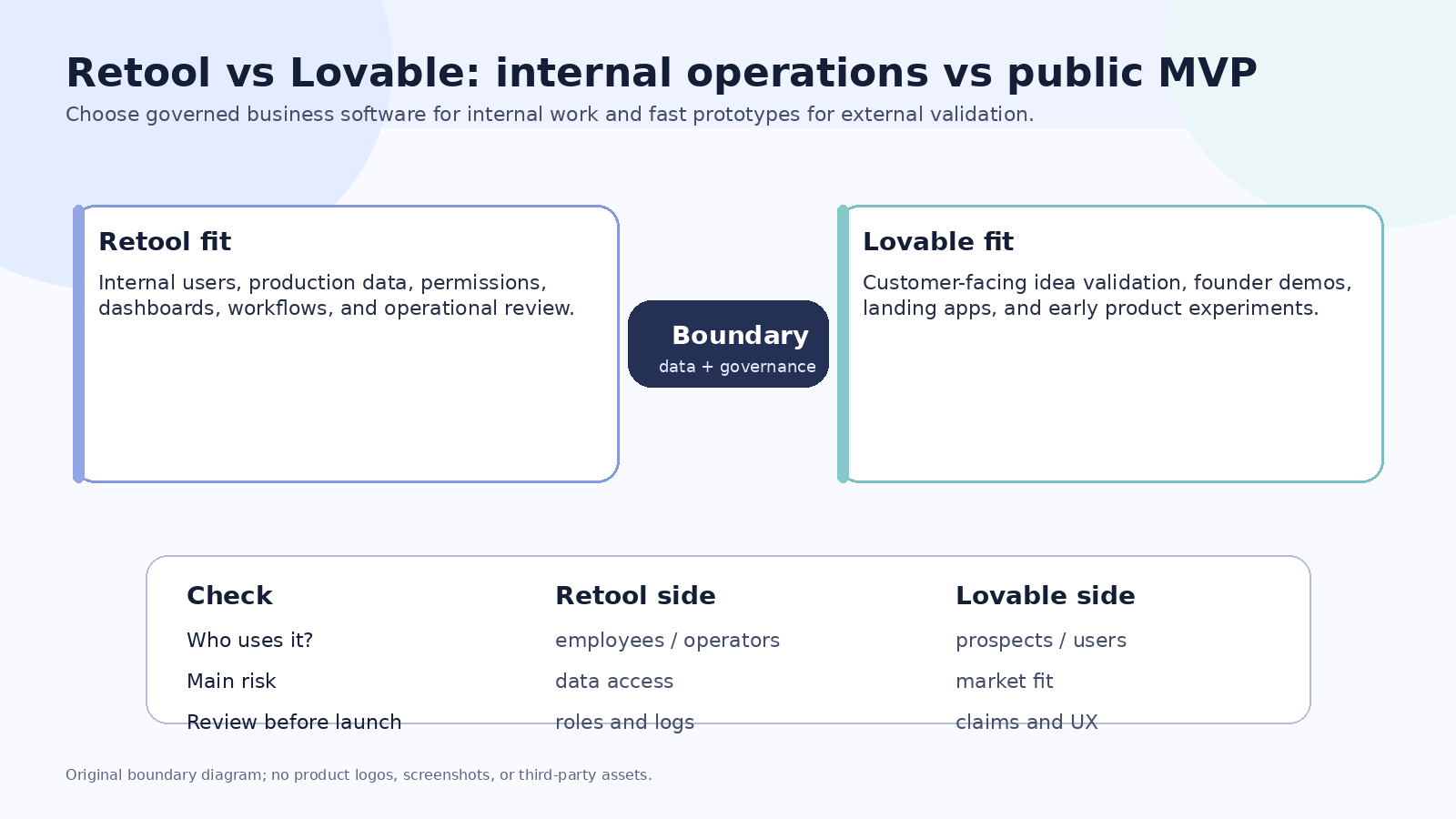
Choose Retool when the app is an internal business tool that needs data connections, permissions, dashboards, approval flows, and operational reliability. Choose Lovable when the app is a public-facing or founder-led MVP that needs fast product validation before a full engineering build.
The simplest rule: Retool is for governed internal software; Lovable is for fast app-style product prototypes.
| Decision factor | Retool | Lovable |
|---|---|---|
| Best use case | Internal tools, admin panels, dashboards, operations workflows. | SaaS prototypes, customer portals, founder demos, lightweight web apps. |
| Primary user | Operations, data, support, finance, internal product teams. | Founders, operators, marketers, consultants, solo builders. |
| Core strength | Connects business data and workflows inside a controlled environment. | Turns product ideas into visible app-style prototypes quickly. |
| Main review question | Are data access, roles, and workflow controls acceptable? | Does the target user understand and want the product? |
| Main risk | Overbuilding internal process before confirming team adoption. | Treating prototype output as production-ready software. |
What Retool is best for
Retool is strongest when the application is meant to support internal operations. The user is usually an employee, analyst, support agent, operations manager, finance teammate, or internal admin.
Use Retool when the app needs:
- Database or API connections.
- Admin panels.
- Internal dashboards.
- Approval flows.
- Data review and editing.
- Role-based access.
- Auditability and operational controls.
- Workflow automation around business processes.
A Retool project is usually judged by whether it makes internal work safer, faster, and easier to govern. Visual polish matters, but it is not the main buying reason.
What Lovable is best for
Lovable is strongest when the application is still a market-facing idea. The user may be a prospective customer, investor, partner, or early adopter. The main goal is not to manage internal data; it is to test whether the product concept makes sense.
Use Lovable when the app needs:
- A public-facing MVP.
- A customer portal concept.
- A SaaS demo.
- A marketplace flow.
- A booking or intake prototype.
- A simple app that can be shown in discovery calls.
Lovable is especially useful when the builder wants to stay in product language: user problem, flow, pages, actions, and feedback.
The key difference: data governance vs market validation
Retool and Lovable can both help people build software faster, but they sit on different sides of the product boundary.
Retool starts to make sense when the app touches operational systems. The harder questions are about data access, permissions, reliability, and team workflows.
Lovable starts to make sense when the app is being used to discover demand. The harder questions are about product clarity, user value, and whether the workflow is worth building properly.
| Question | Better fit |
|---|---|
| Will employees use this to manage business data? | Retool |
| Does this need role-based internal access? | Retool |
| Does this need to connect to databases or operational APIs? | Retool |
| Are we testing a new SaaS idea with prospects? | Lovable |
| Do we need a demo before hiring engineering? | Lovable |
| Are we trying to show a customer-facing workflow? | Lovable |
Use Retool for internal workflow MVPs
Not all MVPs are public products. Some MVPs test whether a team can improve an internal workflow.
Examples:
- A support refund approval queue.
- A finance exception review dashboard.
- A sales operations enrichment workflow.
- An inventory adjustment tool.
- A customer success health dashboard.
- A lightweight CRM admin panel.
For these cases, Retool is often safer than a general AI app builder because the app needs to live near business data and operational rules.
Before launching an internal tool, review:
- Who can view each data field.
- Who can edit or approve records.
- What happens when an action fails.
- What logs or review trails are needed.
- Whether the tool changes source-of-truth data.
- Whether sensitive data is visible in generated screens or test data.
Use Lovable for public-facing MVPs
Lovable is often a better starting point when the product is not yet validated. It lets a founder or operator create something tangible before committing to a full build.
Examples:
- A niche SaaS onboarding flow.
- A booking product for a specific service category.
- A client portal demo.
- A marketplace matching flow.
- A productized service intake app.
- A lightweight community or directory product.
Before showing a Lovable prototype to users, review:
- The promise made on each screen.
- Whether sample data is clearly fake or generic.
- Whether the app implies unsupported payments, privacy, or security guarantees.
- Whether the core workflow can be completed without explanation.
- Whether you are testing demand or pretending the product is finished.
Where v0 and Bolt.new fit
If you are choosing between Retool and Lovable but neither feels exact, your actual need may be different.
Use v0 when you need UI exploration rather than a full internal tool or product MVP. For example, a team may need dashboard concepts before deciding whether to build in Retool. See Lovable vs v0 for the UI-first path.
Use Bolt.new when you want a browser-based development loop and code visibility. For a founder or technical operator, Bolt.new may sit between Lovable’s product-first workflow and a more manual code workflow. See Lovable vs Bolt.new.
Decision checklist
| Check | Choose Retool if yes | Choose Lovable if yes |
|---|---|---|
| Will the app connect to business systems? | Yes | No, or only sample data for a demo. |
| Will employees use it daily? | Yes | Not the first assumption. |
| Does access control matter from day one? | Yes | Only after the concept is validated. |
| Is this for customer discovery? | Not usually | Yes. |
| Is visual product storytelling the priority? | Sometimes | Often. |
| Is the main output an internal workflow? | Yes | No. |
Cost and pricing caution
Do not make the Retool vs Lovable decision only from pricing pages. Plans, usage limits, AI credits, workspace rules, and deployment options can change. More importantly, the wrong category of tool is expensive even if the subscription is cheap.
The hidden cost of choosing Lovable for a governed internal workflow is security review and rework. The hidden cost of choosing Retool for a public-facing MVP is slower market learning if you only needed a demo.
Final recommendation
Choose Retool for internal tools where data, governance, permissions, and operational reliability are central. Choose Lovable for public-facing MVPs where the goal is to test product value quickly.
For a broader replacement map, start with the best Lovable alternatives. For general MVP tool selection, use the best AI MVP builder guide. For data-connected employee software, compare the best AI internal tool builders. If your choice is really between two prompt-to-app tools, compare Lovable vs Bolt.new.